
 Let’s do some role-playing…
You own a flat in Derby and have had the same tenant for six years, a nurse who pays on the first of the month and never rings about the boiler.
Say it clears £9,000 a year after the agent, the insurance, and the repairs. You’re a basic-rate taxpayer, so £1,800 of that goes to the Treasury.
But now, from April 2027, you’ll hand over £2,160 on the same rent, from the same flat, paid by the same nurse.
Welcome to property investing in the UK… and the shiny new first Budget from Chancellor John Healey.
Former Chancellor Rachel Reeves had already set the tax on rental income to rise by two percentage points from April 2027. Healey added two more on top for the fun of it.
The basic rate on property income goes from 20% to 24%, the higher rate from 40% to 44%, and the top rate from 45% to 49%.
The interest on your savings also gets an additional two percentage points. Not a tax on wealth so much as a tax on aspiration.
Healey told the Commons he’d kept Labour’s promise “not to raise tax on working people.” He said the new money comes from “those who can afford to pay.”
As I wrote on Wednesday, they’re clearly happy to add their stealth taxes, too.
He didn’t even have the courage to mention income tax thresholds at all.
Utter cowardice.
So, the tax thresholds stay frozen until April 2031, with the tax-free allowance stuck at £12,570.
It’s also a tax on working people if I’ve ever seen one.
And to pay for their “addiction to welfare,” as Kemi Badenoch puts it, banks are now getting hit, too, with their surcharge doubled to 6% for 15 months from January.
Rest assured, if Labour are still in power in 15 months’ time, that surcharge will stick around even longer.
Duty on higher-stakes gaming machines goes from 20% to 25%, and online marketplaces face tighter VAT rules.
All in all, it’s exactly what you’d expect.
How many new ways can they find to increase or introduce taxes on anyone they possibly can, even those they say they’re not taxing (but really are)?
I want to hear what you think.
Maybe you like some of Healey’s measures?
Maybe you even like the direction of travel here…
Write in and tell me whether this Budget helps you or leaves you worse off, and perhaps even how you’d fix it at investorsdaily@southbankresearch.com.
Britain’s Investment Letter Since 1938
In 1938, The Fleet Street Letter warned its readers that war was coming to Europe — and even identified September as the critical month.
Since then, its readers have been warned ahead of Black Monday, the dotcom crash and the 2008 financial crisis.
Today, Britain’s longest-running investment advisory is still looking for the “news behind the news” — and the investment opportunities others could be missing.
Click here to discover what The Fleet Street Letter sees coming next.
Capital at risk.
What Does Britain’s Oldest Investment Letter See Coming Next?
It warned readers ahead of Black Monday.
The dotcom crash.
And the 2008 financial crisis.
Now, nearly 90 years after it was founded, The Fleet Street Letter is still searching for the “news behind the news” — and the investment opportunities that could emerge from the next major turning point.
Click here to discover what its editors are seeing now.
Capital at risk.
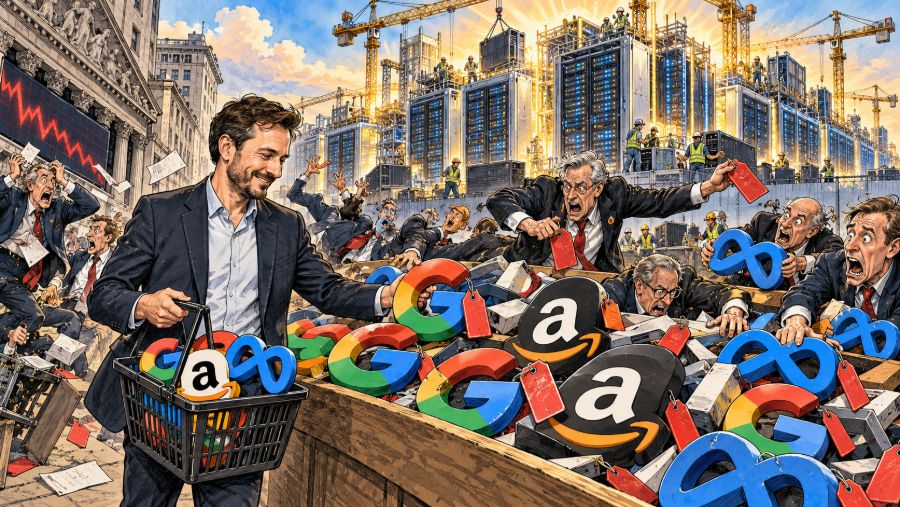
Half a trillion dollars, gone before lunch
Now, Budgets are funny things. They land, we complain (rightfully so), and there’s little we can do about them until an election rolls around.
But whatever the government throws at you, there are some things you can control day to day.
That’s why it’s never been as important as it is today to be an independent, self-directed investor.
And overnight, the markets were dealt a heavy blow, creating a wonderful opportunity.
Alphabet (Nasdaq: GOOGL), the owner of Google, released its third-quarter results after the market closed on Wednesday.
By the next morning, its shares were down 12%, and about $410 billion of market value had been wiped out.
The shares closed Thursday down 12.64% at $283.82.
According to Yahoo!Finance, the company lost $482 billion, marking its worst day on the stock market since Google floated in 2004.
Take a moment to consider that: Its worst day since Google floated.
Through all the ups and downs of the market over the last 22 years, this week saw its worst day.
That’s just ridiculous.
Things aren’t that bad.
So what we’re seeing is a gross overreaction.
And that also means a huge opportunity for the long-term investor.
Why the panic?
Search ad sales grew 12% to $63.35 billion, slower than the 17% in the second quarter and 19% in the first.
Free cash flow, the cash left after paying for new buildings and equipment, came in at negative $9.07 billion.
None of that was unexpected.
After all, capital spending more than doubled in a year, to $51.36 billion in one quarter. They’re not building a company for the next quarter. They’re building out infrastructure to remain relevant for another 22 years.
And it wasn’t just Google.
Amazon (Nasdaq: AMZN) was next.
Its shares fell to around $244 on Thursday before it had even reported earnings. After the close and the official announcement, they were down more than 12%.
Over $275 billion of market value gone in about five minutes of after-hours trading.
Why?
Amazon missed profit “expectations,” reporting earnings of $1.89 a share compared with the $1.97 expected.
Meanwhile, Amazon Web Services (AWS), its cloud arm, grew 39% to $46 billion, its fastest pace in nearly five years.
The AWS backlog rose to $578 billion, up from $496 billion at the end of June.
Amazon’s operating profit jumped to $28.1 billion, from $17.4 billion a year earlier.
It plans to spend about $220 billion on capital projects this year and “meaningfully more” in 2027.
Andy Jassy said:
“What we’re building at Amazon is unlike anything that’s ever been seen before. There has never been a business with a trillion dollars of annual revenue.”
He reckons AWS gets to $1 trillion in revenue within five to 10 years.
Here’s the opportunity gap to exploit as an investor.
There’s a business plan stretching into the mid-2030s, yet the market sold off the stock over an eight-cent-per-share earnings miss in a single quarter.
Meta Platforms (Nasdaq: META) got the same treatment late last week, too. Revenue rose 26% to $64.6 billion, and the shares still fell 7% to $648.85.
Again, the reason was that quarterly capex of $34.9 billion was too much for Wall St.’s liking.
Jog on, Wall St…
One quarter does not make the hyperscaler…
The market wants it this quarter…
So, are these companies in trouble?
Is this sell-off in the biggest hyperscalers a sign of more pain to come and a path towards a deep bear market?
Not the way I see it.
Look at the cash coming in the front door, particularly operating cash flow.
Alphabet’s was $179.6 billion over the past 12 months, and Amazon’s was $168.3 billion, up 29%.
Meta brought in $96.9 billion in the first nine months of this year.
That’s a lot of cash.
Free cash flow went negative because they chose to spend all of that and more on building out the AI infrastructure that will carry them through decades, not just the next quarter.
|
They could, of course, stop. Oracle said it was going to rein in capex in a couple of years, and the market sent its shares into a green-candle frenzy.
But if the likes of Meta, Amazon, or Google simply maintained the status quo, doing only enough to keep today’s data centres humming, it would come at the cost of that $1 trillion-plus in future revenues.
Jassy also told analysts that “almost as fast as we install capacity, customers are gobbling it up.”
An analyst’s model runs to next quarter, while Jassy is talking about the mid-2030s and Alphabet is booking cloud contracts years into the future.
I think that, for all the stuff that’s easy to complain about in the UK, what the US has just presented with this sell-off is a great opportunity.
The best investor in this market is the one who can wait. One year is fine, five is better, and 20 is better again.
I can’t remember a stretch like it.
Alphabet lost 12.6% in a session, Amazon 10% across a day and an evening, and Meta 12.8% in a week. That’s a fair whack off three of the most important infrastructure companies on Earth, all inside a fortnight.
Also, none of this has a jot to do with what Healey says.
Fortunately, they left the £20,000 ISA allowance alone. US shares sit happily in a stocks and shares ISA, and any gains inside it are free of tax.
That’s one of the best tax structures on Earth.
Use that, and if you’ve got a long investment timeframe up your sleeve, I suggest taking maximum advantage of the opportunity this fear has created.
Until next time,
Sam Volkering
Investment Director, Southbank Investment Research
PS Wall Street has just wiped hundreds of billions off some of the biggest AI companies on Earth yet I’m about to sit down with a man who’s spent more than 20 years exploring what AI can actually do for investors. And what he’s built has genuinely surprised me. He’s a former MIT AI scientist, he hasn’t given a face-to-face interview in over 13 years, and he’s agreed to reveal a system that challenges some of the oldest assumptions about stock picking. I’ll be speaking to him on Tuesday 3 November at 4pm, and you’re invited to watch completely free. We’ll even be revealing his highest-conviction stock pick. Secure your viewing pass here. (By clicking the link you agree to automatically be signed up to receive marketing information by email about Resonance AI. You can stop emails at any time using the link provided at the foot of each email.)