
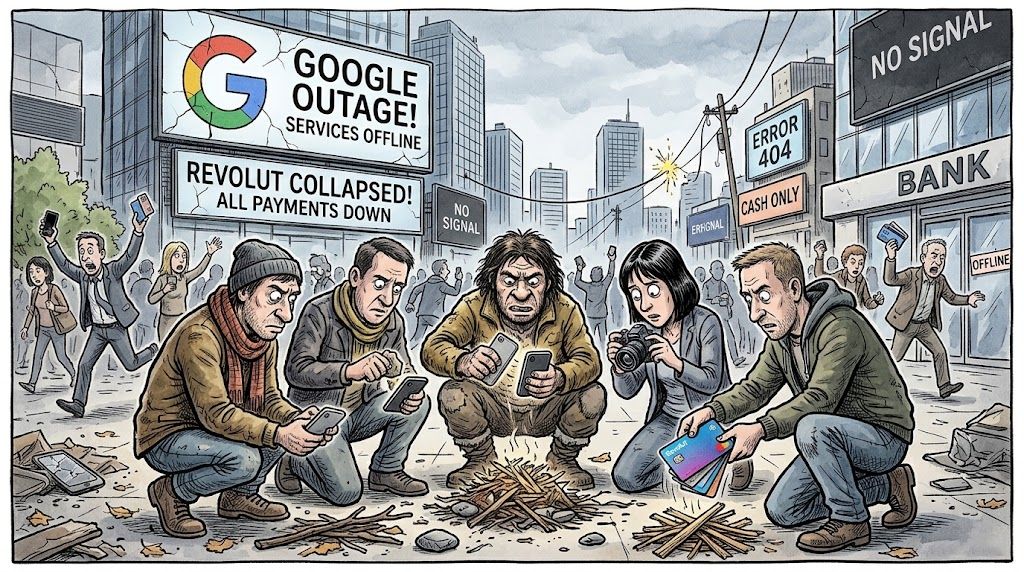
 You’ve been buying crypto through the Revolut app for years. Some of it you’ve saved, and some you’ve made as prices climbed. Last time you looked, it came to about £100,000.
Except this morning, when you open the app to check on your balance, the crypto screen says zero.
You close the app and open it again.
No dice. It still says zero.
You try to move £50 into your current account, and it tells you “something went wrong” and to try again later…
What the heck?
Has £100,000 just disappeared?
It certainly seems that way.
That’s exactly what real Revolut users had to deal with this week.
There were several reports globally of Revolut users finding crypto balances showing “0.” Many investors had portfolio screens completely blank.
The fear must have been excruciating.
The good news is that nothing had been stolen, and Revolut hadn’t gone bust.
The money was all still there, except no one could access it, make transactions, or do anything with their funds.
In 1938, The Fleet Street Letter warned its readers that war was coming to Europe — and even identified September as the critical month. Since then, its readers have been warned ahead of Black Monday, the dotcom crash and the 2008 financial crisis. Today, Britain’s longest-running investment advisory is still looking for the “news behind the news” — and the investment opportunities others could be missing. Click here to discover what The Fleet Street Letter sees coming next. Capital at risk. It warned readers ahead of Black Monday. The dotcom crash. And the 2008 financial crisis. Now, nearly 90 years after it was founded, The Fleet Street Letter is still searching for the “news behind the news” — and the investment opportunities that could emerge from the next major turning point. Click here to discover what its editors are seeing now. Capital at risk. Britain’s Investment Letter Since 1938
What Does Britain’s Oldest Investment Letter See Coming Next?
One power cut in London
What’s said to have happened is that a power problem inside one of Google’s data centres near London sent all corners of the online world into meltdown.
Revolut leans on Alphabet’s (Nasdaq: GOOGL) Google Cloud to run its systems. At 7:08 am UK time on Tuesday, a “power event” knocked out one zone of Google’s London region.
Google wasn’t able to fix it until just before 6pm!
Revolut’s status page listed 28 services as partly unavailable, from card payments and cash machines to transfers and crypto trading.
That’s a bank with more than 80 million customers worldwide and 13 million in Britain.
It wasn’t only Revolut.
Customers of Lloyds (LSE: LLOY), Halifax, HSBC (LSE: HSBA), Bank of Scotland, and Barclays (LSE: BARC) also reported problems. The video system courts use for remote hearings fell over too.
What a day to be on trial, literally and figuratively.
According to The Telegraph, Gemma Atkinson in Crewe had 18 miles left in the tank on the school run. She filled up, the bill came to over £90, and her Revolut card kept declining.
The manager made her sign a form saying she had seven days to pay or she’d be prosecuted!
A father of four in north-west London also told The Telegraph he couldn’t do the big shop for his kids. No food tonight, kids, Revolut is down.
Another said their 71-year-old mother stood at a supermarket till for an hour while her child left work and drove 30 kilometres with cash.
Another couldn’t pay for the taxi to the airport.
Absolute shambles.
Not every “bank” has a master
Your bank doesn’t own most of the computers your money lives on. It rents them from Google, Amazon, Microsoft, or Oracle.
The regulators know it. This year, the Bank of England, the PRA, and the FCA started overseeing all four tech companies as “critical third parties,” because one failure is actually a systemic risk to the banking and financial sector.
If AI agents start transacting with each other at scale, which feature of money could become more valuable?
|
You know what doesn’t fail?
And what kept running?
Decentralised networks like Bitcoin and Ethereum.
Now, you might think that’s great, but how can you, or should you, be storing funds for day-to-day living in Bitcoin or Ethereum?
The truth is, you shouldn’t.
But you should keep a small float somewhere that doesn’t share your bank’s data centre landlord.
Maybe just a few hundred quid, or a grand. Enough for a tank of fuel or two and a week’s shopping.
And you can do that with something like a MetaMask account and payment card.
Coincidentally (maybe) MetaMask reopened UK sign-ups for its MetaMask Card on Tuesday, the same day Revolut went dark.
It’s a Mastercard that pulls from your MetaMask wallet at the till. It can spend a pound stablecoin, so you could even just store some pound-denominated stablecoins in a MetaMask wallet and have them as your emergency cash. Or park the funds in crypto, and if you ever need them at short notice, just convert, tap, and spend.
The Coinbase Card is open to UK Coinbase customers too. That one of course means funds in a Coinbase wallet, but again, this is an alternative, not an out and out solution, at least not yet.
But maybe as these “DeFi” options become more secure, safe, and trusted, they’ll become the standard accounts?
Somewhere you can earn a yield (interest) on stablecoins that’s slightly better than what you’d get at the bank, without being at the mercy of a controlling bank overseeing your every move, or the likes of Google should they have another outage.
At a minimum, I would say try it out, test it, experiment, and see how it goes, even with just £50 or £100 in your account.
Then use it at an actual petrol pump, on a day when nothing’s gone wrong with your normal banking.
That way, if and when things do go wrong with your normal banking, you can simply keep calm and carry on.
Until next time,

Sam Volkering
Investment Director, Southbank Investment Research
PS One power cut in London was enough to leave millions of people wondering whether they could access their own money. It’s a reminder of just how dependent Britain has become on systems it doesn’t control.
But there’s another side to Britain’s future that I think deserves your attention.
While we’re worrying about the reliability of our financial infrastructure, a potentially enormous energy opportunity could be sitting just off a remote British island.
Some estimates put the oil resources in the surrounding region at 183 times the size of the North Sea.
And I’ve identified a little-known British company, with shares trading around £1, that I believe could be well placed if this opportunity develops.
It’s a very different kind of investment story, but one that could have enormous implications for Britain’s future.
See why I believe this could be Britain’s second North Sea oil moment here.