
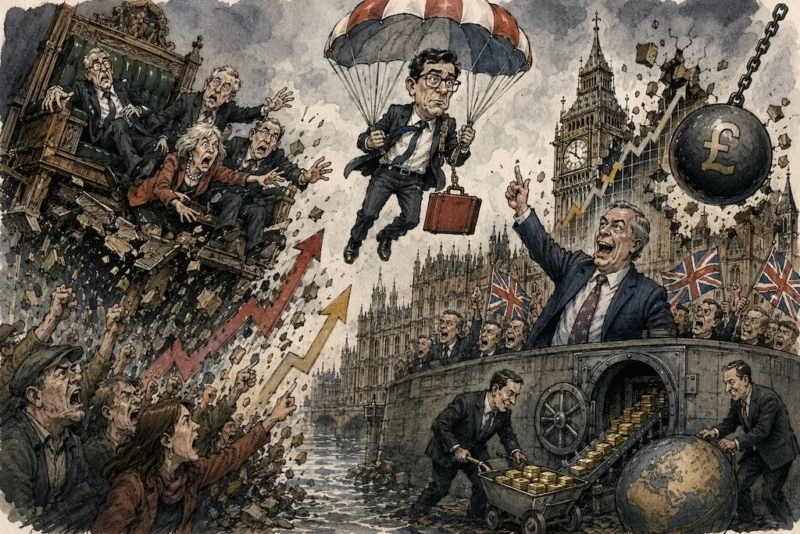
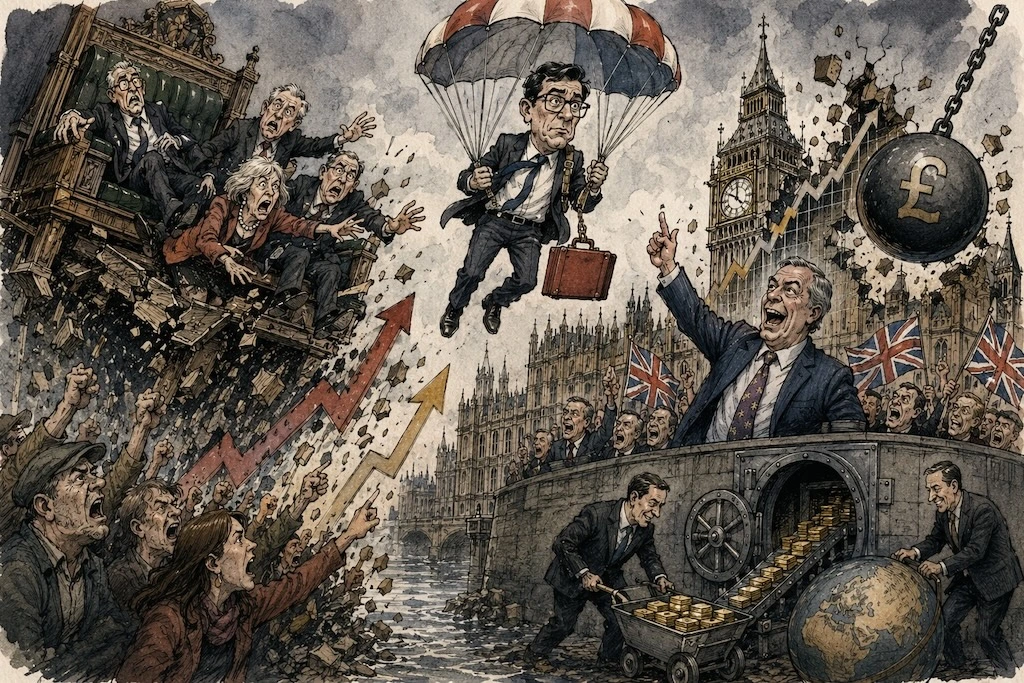
 Last Thursday, Josh Simons, the Labour MP for Makerfield, walked into the chamber and resigned the seat the voters of Makerfield gave him two years ago.
He didn’t lose his seat, there was no scandal that ousted him, he simply gave it up because he was told to.
The Labour government scored and assessed all seats held and candidates in “sure thing” seats, and determined it was Makerfield that needed to be vacant so that Andy Burnham, currently Mayor of Greater Manchester, could take it and use it as a runway to Number 10.
It’s the first time in over sixty years that a Westminster by-election has been engineered specifically to install someone in Parliament.
And in doing all this, we can be certain that no one consulted the voters of Makerfield.
In January 1965, Harold Wilson needed his Foreign Secretary, Patrick Gordon Walker, back in the Commons after he had lost his seat at the previous election.
Reginald Sorensen, the long-standing Labour MP for Leyton, was persuaded to take a peerage and clear the way. The seat had a 7,926 majority. Considered safe.
Gordon Walker lost the by-election by 205 votes. He resigned as Foreign Secretary the next day. Wilson’s Commons majority collapsed from four to two, and sterling started its slow march toward the 1967 devaluation, when the pound was cut from $2.80 to $2.40 in a single weekend.
The voters of Leyton didn’t think the seat belonged to Westminster. They thought it belonged to them.
I suggest that we’re about to find out just how much the British public like to be told what to do by the establishment. And if the current temperature of the country is anything to go by, there’s nothing “safe” about Makerfield for Burnham.
In fact, if this swings to Reform and Labor lose the seat, strap in because a general election will be on the way, and the UK stock market will rip higher off the back of it.
Britain’s Investment Letter Since 1938
In 1938, The Fleet Street Letter warned its readers that war was coming to Europe — and even identified September as the critical month.
Since then, its readers have been warned ahead of Black Monday, the dotcom crash and the 2008 financial crisis.
Today, Britain’s longest-running investment advisory is still looking for the “news behind the news” — and the investment opportunities others could be missing.
Click here to discover what The Fleet Street Letter sees coming next.
Capital at risk.
What Does Britain’s Oldest Investment Letter See Coming Next?
It warned readers ahead of Black Monday.
The dotcom crash.
And the 2008 financial crisis.
Now, nearly 90 years after it was founded, The Fleet Street Letter is still searching for the “news behind the news” — and the investment opportunities that could emerge from the next major turning point.
Click here to discover what its editors are seeing now.
Capital at risk.
The “what if he loses” trade
Let me step you through this, or at least my logical thoughts on it.
What happens if Burnham loses Makerfield?
A big part of this seat is Wigan. And look at the local election numbers from just a couple of weeks ago. As the Manchester Evening News wrote,
“The Labour Party endured a catastrophic night in Wigan and Leigh as voters gave them “a kicking”, with Reform UK winning 24 out of 25 seats up for grabs.”
At the 2024 general election, Labour won here by 13 points.
Just 18 months later, Reform is reportedly doubling Labour’s vote share at the local level, and Nigel Farage has openly vowed to take the seat.
If Burnham loses, the leadership challenge and any realistic path to Number 10 probably dies immediately.
He can’t challenge Keir Starmer without a Commons seat. And politically, it’s hard to imagine Labour trying to engineer another constituency vacancy for him after a defeat like that.
Starmer would be technically vindicated, but politically weakened all the same, because the result would reinforce a far bigger fear inside Labour: that seats once considered untouchable may no longer be safe at all.
And with nearly 100 MPs reportedly already unhappy with his leadership, the pressure to replace him would intensify very quickly.
But Starmer doesn’t strike me as the sort of politician who simply steps aside quietly.
He may decide to go down swinging.
Call a snap election.
Force the issue.
And let whoever replaces him deal with the aftermath.
Maybe figures like Angela Rayner or Ed Miliband step forward.
And maybe ego, ambition, or simple political necessity convinces them to seek their own mandate through a general election while Labour still has enough seats to remain competitive.
Or perhaps Labour does the opposite.
New leader.
No election.
A zombie government slowly bleeding support, seats, and credibility over the next several years.
Whichever version plays out, I suspect markets to begin sniffing out political change long before Westminster fully catches up to it.
And that’s where things start becoming interesting for investors.
Because whatever people think about Reform politically, markets increasingly view the party as more pro-business than the current government.
Not quite Liz Truss territory, but not miles away either.
And we all remember how violently markets reacted to the Truss experiment, both the good and the bad.
Bond yields exploded higher.
Sterling swung wildly.
And somewhere in the middle of it all, a lettuce famously outlasted her premiership.
There are still legitimate concerns around debt, fiscal credibility, and whether Reform can realistically balance pro-growth promises with economic reality.
But you can already see parts of the rhetoric beginning to soften as the realities of government come into view.
Because eventually, every political movement discovers that promising everything to everyone collides with arithmetic.
Still, even with uncertainty, rising bond yields, and ongoing pressure on sterling, a more pro-business backdrop combined with a reopening of the North Sea, a friendlier digital-assets policy, and renewed focus on economic growth could create a surprisingly constructive backdrop for UK equities over time.
And if that political shift really begins gathering momentum, markets may start pricing it in long before the ballots are cast.
Let’s not forget that around four fifths of the FTSE 100 sales come from overseas. So, a 5%, 10% clip on sterling does wonders for the bottom line of PLCs trading on the LSE.
The sterling crisis might be useful
Within hours of the Burnham announcement, the 30-year gilt yield climbed to 5.86%, its highest level since 1998.
The 10-year yield touched 5.14%.
Sterling slid to a one-month low and posted its worst week against the dollar since 2024.
Now, from a trading perspective, a weaker pound can actually be helpful… if your country exports things.
The problem is, Britain imports a huge amount of what it consumes.
But perhaps what’s happening in Makerfield becomes the moment the pendulum finally starts swinging back the other way.
Perhaps this is the point where British manufacturing, energy independence, and industrial policy slowly begin moving back into focus.
Even something as simple as reopening the North Sea, becoming more self-sufficient in energy, and easing away from the more extreme edges of Net Zero policy would have a meaningful economic impact.
Because cheap energy still matters.
It always has.
Cheap energy tends to lead to economic growth.
And maybe that broader shift is exactly what starts pulling Britain back towards a more productive economic footing again.
Oddly enough, it may begin with something as small as a by-election.
A moment where voters stand up and remind Westminster that seats belong to the public, not the political machine.
Of course, voters may still choose to send Andy Burnham to Parliament. That is entirely their right.
But even if he wins, it’s difficult imagining a sweeping mandate here.
And if the margin ends up narrow, say under 1,000 votes, it only reinforces how fragile the government’s position may already be.
Even in a scenario where Keir Starmer becomes politically untenable, and Burnham eventually makes a successful leadership run, there’s still a broader issue underneath all of this:
British voters were never really consulted on any of it.
Personally, I’ve long thought any change in Prime Minister should automatically trigger a general election.
That’s not how the system works today, unless Parliament eventually changes it, but the political pressure building underneath the surface feels increasingly difficult to ignore.
Labour is dealing with internal divisions and leadership tensions.
The Conservatives still look directionless.
And Nigel Farage and Reform continue polling strongly across large parts of the country.
Whether people like that or not politically, it does create the sense that something is shifting in British politics.
Now, all of this uncertainty is naturally uncomfortable for gilt markets and sterling.
Political instability usually is.
But interestingly, I don’t think the trade here necessarily becomes “sell Britain”.
In fact, I think there’s a strong argument the trade may ultimately become: buy the UK.
Particularly the FTSE 100 Index (^FTSE), alongside selected pockets of the market such as smaller oil and gas companies, mining stocks, and British digital-assets and technology businesses.
We’ve now got roughly a month to see how this plays out.
Because the Makerfield result may end up becoming far more than just a route back into Westminster for Burnham.
It could become one of those strange political moments that, in hindsight, people point to as a genuine turning point in modern British politics.
And while I’ve got you here, I’d genuinely like to hear what you think happens on 18 June.
Do voters accept Burnham’s move into Makerfield?
Does Reform make it a genuine contest?
And what do you think any of this means for the future political and economic direction of Britain?
Send us an email and let us know.
There are no right or wrong answers here, just your view of where the country may be heading from this point.
Send to feedback@southbankresearch.com.
Until next time,

Sam Volkering
Investment Director, Southbank Investment Research
PS Political instability tends to scare investors away from Britain.
But historically, some of the best opportunities emerge precisely when markets are distracted by Westminster chaos.
If I’m right about where this political shift is heading, then UK energy, mining, infrastructure, and domestic industrial plays could end up becoming some of the biggest beneficiaries of the next phase of British policy.
That’s exactly why Jim Rickards recently issued a major update on what he calls America’s “Birthright” trade, and why he now believes the opportunity is accelerating far faster than even he originally expected.
In that briefing, he reveals one stock he believes could directly benefit from the next wave of resource and industrial investment now unfolding.