In today’s Issue:
- How the politics of policy, outcome, and envy failed
- The Cobra is hissing again
- Investors had better be ready for a new type of government
Political debate and discussion have become impossible.
These days, we can’t even agree on what outcome would be a good one.
But it goes deeper…
We can’t agree which policies are a good idea.
Nor can we agree on what the real-world consequences of those policies would be.
So, even if we could agree on the goal, we’d still be left debating which policies would actually achieve it.
Our timeframes aren’t aligned either.
Some of us want the government to redress past generations’ ill deeds. Some want the present to improve, now! While others only think about the long-term future.
The metrics of our conversations are completely out of whack.
This divergence has been getting worse over time.
But why? What happened?
Literal divergence
Politics used to be about choosing between different policies.
Higher or lower taxes. More or less government spending. The liberalisation of marriage laws, sexuality and abortion…or the status quo.
This allowed voters to choose what they wanted politicians to do. And kept politicians debating their policies instead of each other’s backgrounds, beliefs or ulterior motives.
Debates were actual debates, about what government should do next.
Why we might want to achieve a certain outcome wasn’t questioned.
Whether the policies would actually work was hardly mentioned.
Questioning the underlying intentions and ulterior motives of the politicians proposing policy was beyond the pale.
Politicians were publicly elected technocrats, doing the voters’ will.
Then politics shifted.
During the late 70s and 80s, people began to realise that political policies often backfire.
Price controls, economic stimulus, and wage hikes make inflation worse. Socialists run out of other people’s money. Tax hikes can reduce tax revenue.
The entire language of politics shifted. People stopped believing politicians. “I’m from the government, and I’m here to help” changed from the government’s motto to a point of ridicule.
Governments deregulated to free up the economy. Government spending as a share of the economy fell. Even Labour aligned itself with these ideals under Tony Blair.
In the 2000s, there was another upheaval in the nature and language of politics. It became about selling outcomes. A marketing exercise completely devoid of policies.
Voters had a choice between which causes they wanted pursued. Elections became about saving the planet from carbon dioxide, addressing gender, wealth and income inequality, tackling homelessness or promoting home ownership, ending poverty, or importing poor migrants.
The problem with this is that politicians stopped detailing their policies, let alone debating their efficacy. How exactly politicians promised to achieve their goals was left simply unsaid. A detail for the civil servants to figure out.
All too often, the actual policies came as a complete surprise to voters. Ask people whether they want to stop climate change, and they will say yes. But carbon taxes, emissions trading schemes and subsidies are unpopular.
This gap completely mystifies politicians and public servants. The rest of us think it’s obvious.
Campaigning on outcomes also allowed politicians to be vague. Being pro-women on the campaign trail can amount to two diametrically opposite outcomes.
Instead of promising to bring inflation down or GDP up, politicians promise “hope,” “reform,” and “change.” After all, who isn’t in favour of those?
A lot of people, once they become actual policy, it turns out…
When the outcomes differed from what politicians had promised, they only doubled down harder. That’s because they simply presumed their policies work. There was no political debate about whether they would.
I left the UK in 2016, just after the Brexit vote. Politicians were promising to implement the people’s will. Then I lived in London again from 2017 to 2020. I don’t think anyone expected how the Brexit negotiations unfolded, or what the deal ended up looking like.
Then immigration surged after Brexit, under Brexiteer governments and ministers.
The politics and the outcome could not have been more disjointed because there was no policy debate.
Today I’d like to point out that all these political paradigms fell prey to the same single killer – a cobra.
And I’ve just heard a hissing sound coming out of Westminster again.
But first, a description of the political paradigm of today…
Britain’s Investment Letter Since 1938
In 1938, The Fleet Street Letter warned its readers that war was coming to Europe — and even identified September as the critical month.
Since then, its readers have been warned ahead of Black Monday, the dotcom crash and the 2008 financial crisis.
Today, Britain’s longest-running investment advisory is still looking for the “news behind the news” — and the investment opportunities others could be missing.
Click here to discover what The Fleet Street Letter sees coming next.
Capital at risk.
What Does Britain’s Oldest Investment Letter See Coming Next?
It warned readers ahead of Black Monday.
The dotcom crash.
And the 2008 financial crisis.
Now, nearly 90 years after it was founded, The Fleet Street Letter is still searching for the “news behind the news” — and the investment opportunities that could emerge from the next major turning point.
Click here to discover what its editors are seeing now.
Capital at risk.
Identity politics doesn’t care about the future
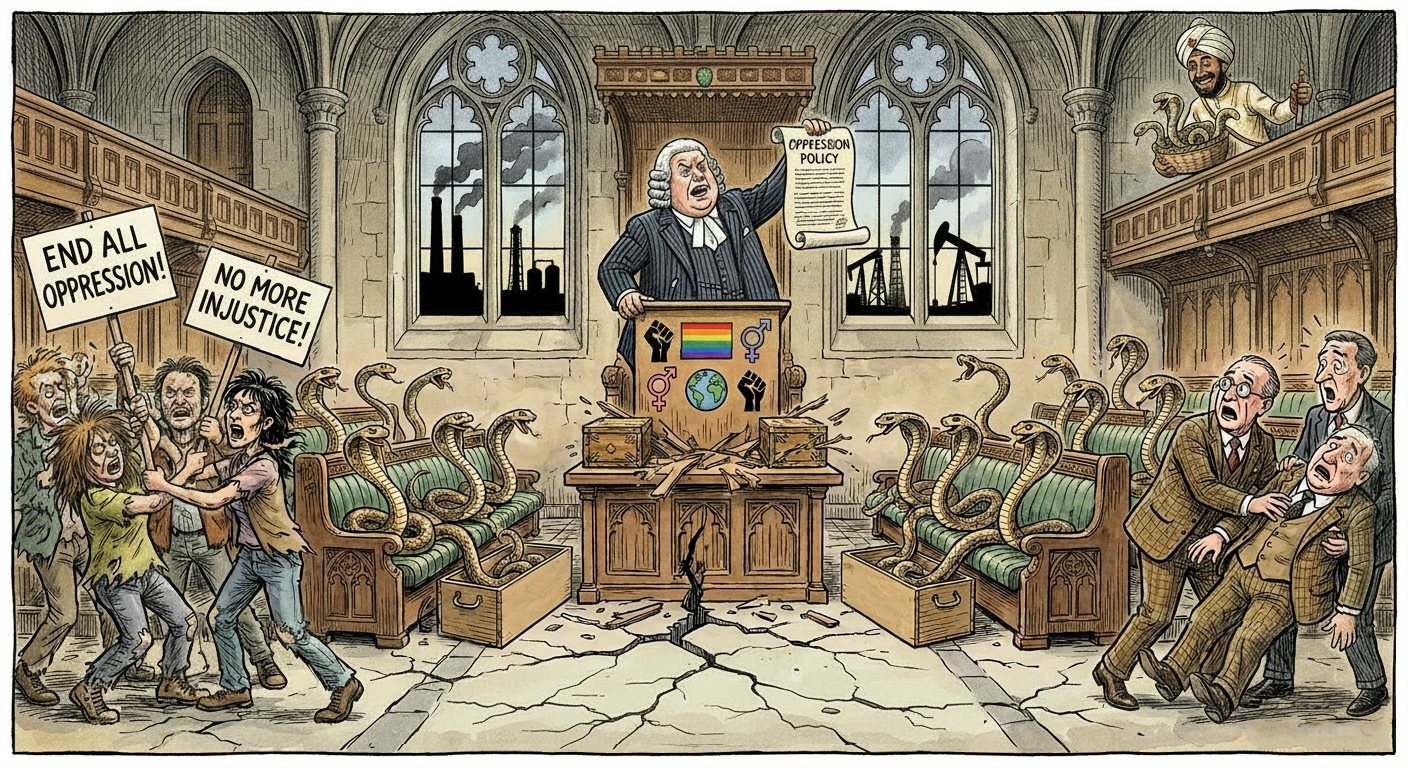
The next phase of politics is still fairly new. It is based on prejudices, redressing past injustices and victim mentality. Think of it as the politics of oppression.
The world is divided into two groups of people. The oppressed and the oppressor. Politics is about backing the oppressed and making the oppressor pay.
People are defined by the colour of their skin, not by the content of their character or what they’ve been up to lately… on inequality, race, religion, gender, climate change, and sexuality. It is about finding a victim and helping them fight their victimiser.
You must always root for the underdog, even if they stand for the exact opposite cause to you.
This thinking gave us reparations, net zero, reverse racism, and some very odd welfare policies.
Under this form of politics, both the policy and its outcome are irrelevant. Politics is about causes. It sells awareness of past injustices instead of solutions. It’s about taking a stand, whichever way you might be facing.
Debates are about who is speaking and what group they are part of. The content of each person’s speech is irrelevant. No point listening.
Even the Soviet Union didn’t get to the point where maths was considered a violation of people’s rights. Yet it has today. Maths can be racist. Universities ended entrance requirements in order to promote admissions for the mathematically oppressed.
If you ask two groups of protestors today what’s wrong with the world, you will get extraordinarily similar answers. If you ask them what we should do about it, you get surprisingly similar answers.
Yet they take to the streets to oppose each other!
Their opposing protests are about their background and identity. And they are willing to fight each other over it… despite agreeing on what’s wrong and what policies should be pursued to fix it.
But today, I want to tell you that the tide is turning once again.
Bitten by the Cobra Effect
The politics of oppression may not have a coherent policy platform. But they have been busy.
Sadly, for them, it hasn’t been going well.
Inequality continues to worsen. Women feel more unsafe. Climate change is on the back burner. Energy prices are high. Inflation is high again.
As a result, right-wing populist parties lead in polls in many countries.
But it’s not just that the government policies and desired outcomes of identity politics were disjointed. It’s that the policies all too often lead to the opposite outcome.
Economists call this the Cobra Effect. It is probably the economic theory that most defines my own ideological beliefs. So I won’t be shy explaining….
Government policies everywhere and always backfire. Usually, by delivering precisely the opposite outcome to what was intended. Sometimes, by creating a bigger and worse problem elsewhere.
The theory is named after the British government’s attempt to reduce the number of cobras in a city in India. They decided to pay locals per cobra skin to incentivise a cull. Think of it as the renewables subsidy of its day.
The trouble is that entrepreneurial Indians soon began to farm cobras as a business.
The government eventually cottoned on to the fact that its policy wasn’t achieving the intended outcome. So they cancelled the payments.
You can imagine what the cobra farmers did in response. The streets were flooded with cobras. It got ugly.
Well, it’s getting ugly in today’s politics too.
Grievance politics is sinking under the weight of its own contradictions
The political parties leading polls around the Western world are the antithesis of what our politics looks like today. So different that most countries have a “firewall” – the legacy parties refuse to cooperate with them at all.
The new crop speaks an entirely different language. They believe in cheap energy over green. They know what a woman is. They believe in individuals’ merit over class.
It is incredibly ironic that those pushing the politics of oppression were caught out over antisemitism and feminism. But political change loves irony.
It’s not just the political arena. Universities like Yale are bringing back standardised testing.
The “go woke go broke” phenomenon proved that socialists eventually run out of other people’s money in the private sector, too.
BP has unofficially changed its motto yet again. We’ve gone from “British Petroleum” to “Beyond Petroleum” to “Back to Petroleum.”
And that gives us our first investment hint, doesn’t it?
What does this radical shift in politics mean for investors?
I don’t know what the next phase of politics will look like. The last few eras don’t make much sense to me. So it would’ve been hard to predict them.
I also don’t know what the language will look like. I’m just not hip enough.
But with physics and biology reasserting themselves, I think we can take a guess at some of what comes next…
Governments will prioritise prosperity over other causes. Globalisation will be seen as relying on the benevolence of strangers. And natural resources will be national resources.
Even Labour politicians are coming out in favour of North Sea oil, for example.
And that hints at the opportunity to come.
The crucial realisation investors need to be aware of is that our current political class is clueless. They don’t know about policies. They don’t care about outcomes. And grievance policies are a minefield because it shifts so fast. How often have we seen activist movements turn on their own?
Soon, it will collapse under its own contradictions.
And then we’ll get something entirely new, again.
Until next time,

Nick Hubble
Editor at Large