In today’s Issue:
- How peace in our time will spike the oil price
- Oil’s supply chain inertia will turn from strength to weakness
- Where will the profitable bottlenecks be?
Another day, another whipsaw in energy markets. Action in the Strait of Hormuz has developed into headline tennis. Investors are getting a sore neck watching the oil and gas price yo-yo in response.
So far, the oil price has reacted to news of peace by falling. Then it spikes higher each time the news turns sour, or worse.
But what if this is precisely the wrong reaction?
What if peace with Iran and the reopening of Hormuz would actually cause oil prices to rise in coming months?
The oil supply chain has the inertia of a supertanker
The biggest mystery facing oil markets this year is why the oil price hasn’t surged far more.
Give an oil analyst the theoretical scenario we see in the news today and they’d give you an oil price around $150.
We’ve barely cracked $100 on the bad days.
Why?
That’s hotly debated.
It might be because the crisis would be so bad if the Strait of Hormuz remains closed that nobody expects it to be for much longer…
Or perhaps ships are actually sneaking out despite the threats?
Another explanation is that oil’s supply chain has a lot of inertia. Fully loaded ships continued to arrive weeks after the Strait of Hormuz was closed.
Then, import terminals still had plenty of inventory to work through.
As did refineries.
The next large government oil storage began to drain.
And then you’ve got the inventory of all the useful goods that oil is actually processed into. Diesel tanks, plastics inventory, and all the rest of it.
The point is that we have plenty of time to sort out the situation with Iran.
Scratch that.
Had plenty of time.
Now the world is beginning to worry that we were too complacent.
Our toilet broke a few weeks ago. We are unable to get the new one delivered because of supply chain chaos affecting building materials.
So, yes, things are getting serious.
But what happens next might be astonishingly counterintuitive.
Over the past two weeks, I have developed a theory that says the mainstream and the oil price’s daily swings have got it terribly wrong.
What if the energy crisis actually hits once the Strait is reopened?
What if the recovery triggers the oil price spike we feared?
Britain’s Investment Letter Since 1938
In 1938, The Fleet Street Letter warned its readers that war was coming to Europe — and even identified September as the critical month.
Since then, its readers have been warned ahead of Black Monday, the dotcom crash and the 2008 financial crisis.
Today, Britain’s longest-running investment advisory is still looking for the “news behind the news” — and the investment opportunities others could be missing.
Click here to discover what The Fleet Street Letter sees coming next.
Capital at risk.
What Does Britain’s Oldest Investment Letter See Coming Next?
It warned readers ahead of Black Monday.
The dotcom crash.
And the 2008 financial crisis.
Now, nearly 90 years after it was founded, The Fleet Street Letter is still searching for the “news behind the news” — and the investment opportunities that could emerge from the next major turning point.
Click here to discover what its editors are seeing now.
Capital at risk.
Like a production gapper
To explain my idea, let’s use a theory I developed for the mid-cap mining industry…
Mines deplete over time. So mining companies are constantly having to find new projects.
The profits from the existing mine are used to fund the upcoming mine. They have to make sure their next mine is up and running before their existing mine depletes.
Without the cash flow from the existing mine, the company would have to raise new funds to finance its upcoming project. And dilution is the only thing mining investors fear more than political risk.
A “production gapper” is a mining company whose next project is going to be delayed beyond the depletion of its current mines. It is a ticking time bomb for investors.
The oil market faces the same type of air pocket. Just as it takes weeks for the end of oil supply through the Strait of Hormuz to become a problem at the petrol pump, it’ll take weeks for new oil to actually fill the gaps.
The supply disruption doesn’t end the day Trump declares “peace in our time” and the Strait reopens. It ends when the whole oil supply chain is refilled with the oil and oil-based products we need.
That’ll take time in the best-case scenario.
The real trouble is that demand will continue in the meantime…
Plus, governments will want to restock their depleted storage…
And then there’s deferred demand as buyers hold off their purchases while oil prices are high because of Hormuz.
The oil supply chain is not used to meeting existing demand, meeting pent-up demand, refilling government storage, and restocking the existing supply chain all at the same time. It is used to meeting predictable and steady levels of demand, end of story.
Oil supply chain infrastructure is run at or near safe capacity during normal periods. Companies operating that infrastructure don’t sit on spare capacity waiting for the Strait of Hormuz to close and reopen.
Instead, the oil market relies on the price to regulate demand to meet supply. That’s why the oil price moves so much.
If demand within the supply chain consists of the usual consumption plus refilling storage plus making up for lost production time plus deferred buying, that’s a serious spike in demand. That should see oil prices spike… a lot.
But even if oil production could spike in the short term to meet a spike in demand, this would only create new bottlenecks in places like shipping, refining and the production of the goods we actually use.
And that’s why things get interesting for investors.
Where will the bottlenecks be after Hormuz is unclogged?
Profits are made by those who control bottlenecks. They receive the higher prices that result from supply shortages. And constrain the rest of the market’s ability to meet demand.
Our modern economy is full of long supply chains. Which means they have plenty of bottlenecks.
Where are the bottlenecks in the oil supply chain?
In the infrastructure. Shipping, refining, and the pipelines and terminals that connect the two.
Their capacity is not price-dependent in the short run because of the time and money it takes to build such infrastructure. The investment decisions are based on long-term projections, not short-term disruption.
During the current oil crisis, it’s the divergence between oil and oil-based products that has generated whopping profits.
This is known as the crack spread. The gross profit margin an oil refinery makes by turning crude oil into refined petroleum products like gasoline and diesel. The crack spread has doubled since the Iran war began.
The West, conveniently, has just dismantled much of its refining capacity. The countries that still have theirs will want to return their own economies and operations to normal before exporting oil-based products.
And then we’ll hit bottlenecks in shipping, pipelines, terminals, and other infrastructure.
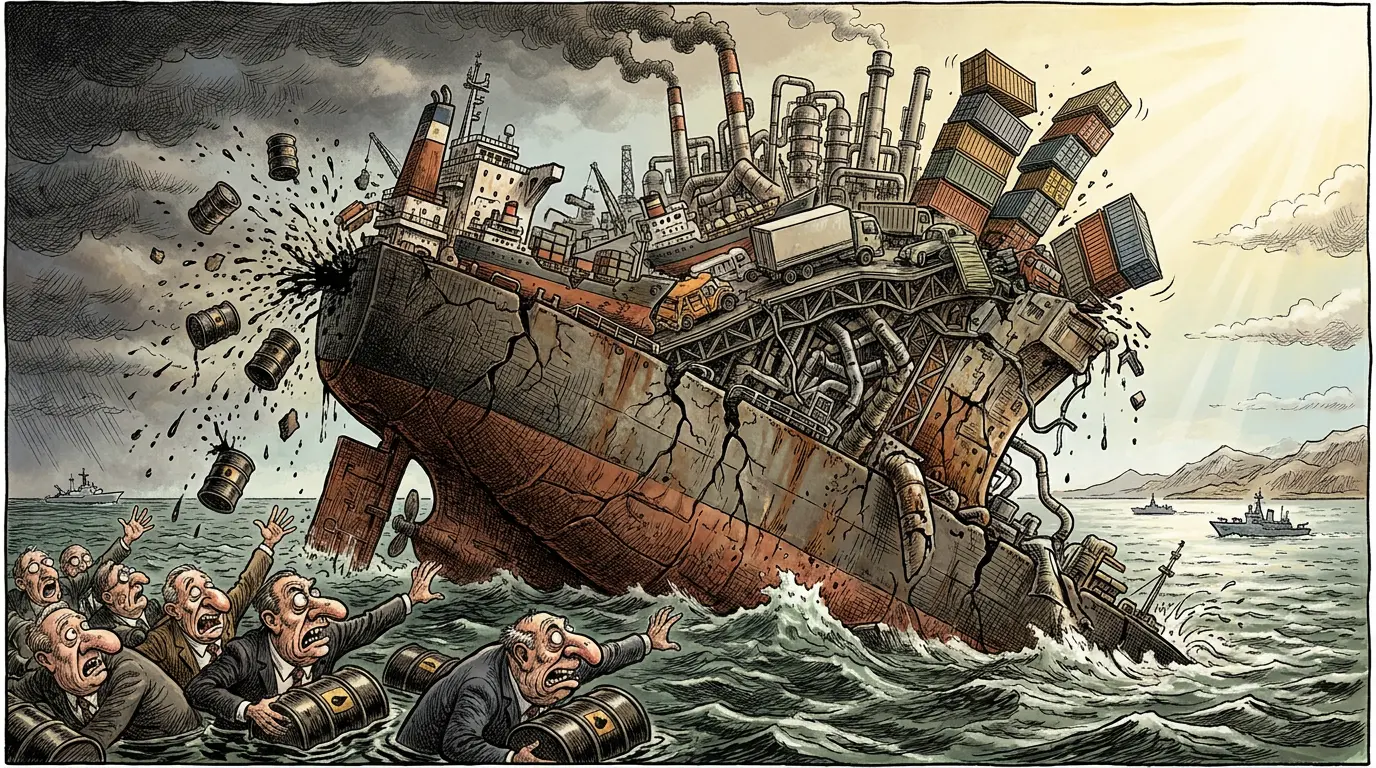
The point is that the oil market will resurface from the reopened Strait of Hormuz with a serious case of the bends. The crisis may occur during the recovery.
One investor who has prepared for all this is Jim Rickards. He guided his readers to invest in the companies that operate the energy infrastructure that could become critical bottlenecks in the coming weeks.
But that’s not the only market where Jim sees investors making a dangerous assumption.
He believes the same mistake that devastated portfolios during the dot-com crash may be happening again today in AI.
The technology is real. The excitement is real. But when you follow the money, the picture starts to look uncomfortably familiar.
You can watch Jim’s full briefing here.
Until next time,

Nick Hubble
Editor at Large