
Publisher’s Note: Fear in and out of markets is growing day by day. To best help you navigate this, we’re turning our focus to what this war means for you and your investments… and offering additional ways you can continue to grow your wealth through it all.
– Elizabeth Cox
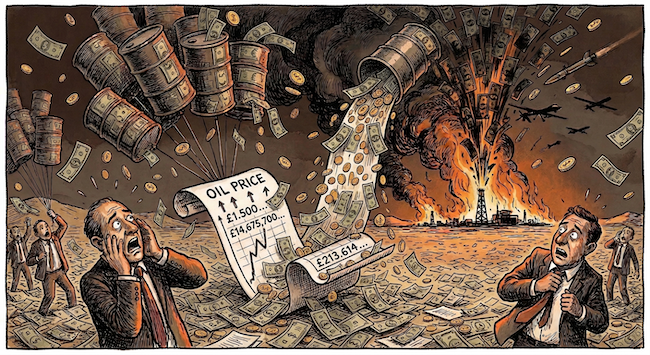 Israel bombed Iranian oil infrastructure overnight. The US, by all accounts, is not happy about it.
Not because they don’t back Israel. They do. But burning oil fields are terrible optics when American petrol prices are nudging $4 per gallon and climbing.
And when you’re heading into midterm elections on a platform of easing the cost of living for “everyday Americans”, soaring fuel prices are a fast-track path to losing seats.
Oil crossed $111 per barrel as I write this. Getting to $120 now feels almost inevitable. Beyond that, $150 becomes a real possibility. And if the situation on the ground deteriorates further, $200 is no longer wild speculation.
You should also get used to hearing the term force majeure.
It’s a standard contract clause that allows suppliers of things like gas, chemicals or fertilisers to delay or cancel deliveries because of events outside their control.
QatarEnergy, one of the world’s largest gas suppliers, has already declared it. So have other major commodity producers, from PT Chandra Asri Pacific (petrochemicals) to Kuwait Petroleum (oil) and Sumitomo Chemical Asia.
These developments have knock-on effects everywhere — fertilisers, jet fuel, plastics, mining, packaging. The list is long. And they shatter the value of most risk assets.
That is why Asian markets were hit so hard. Korea triggered another circuit breaker. Australia’s market fell around 5%. Japan wasn’t far behind.
What happens next from the US isn’t difficult to guess.
Militarily, the US and Israel appear to have the upper hand over Iran.
But arguably more dangerous than a strong enemy is a collapsing one. Right now, the Iranian regime looks fractured, disorganised, and without a clear chain of command.
That’s chaos. And chaos, as any trader or investor will tell you, is the one variable that markets cannot price — but fear the most.
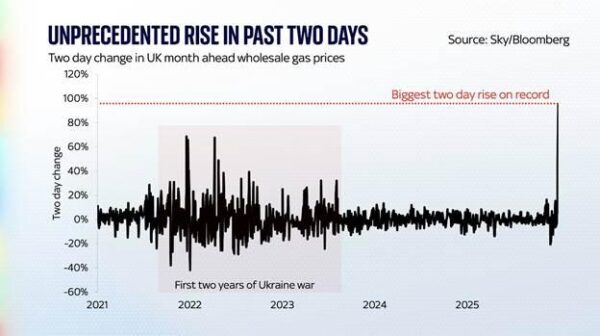
Take a look at UK gas prices last week.
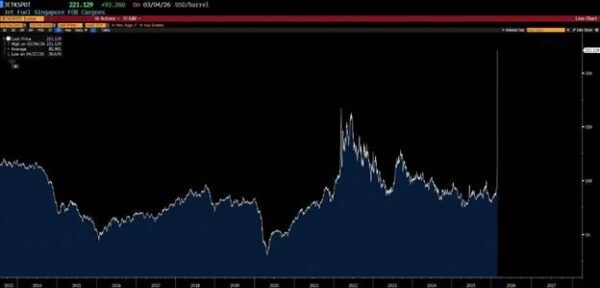
Then Singapore jet fuel.
And finally crude oil itself.
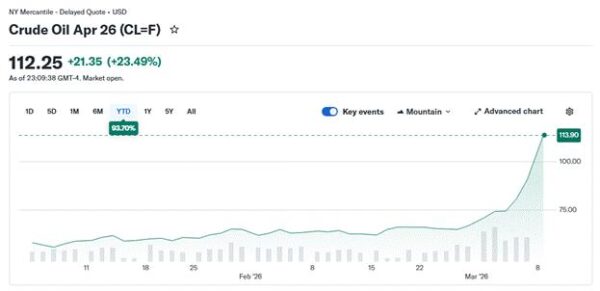
All three tell the same story in slightly different commodities.
Fear is peaking. Markets are now pricing in massive supply shocks (and rightly so). Capital is fleeing almost everything.
Even gold has fallen as investors sell whatever they can to cover margin calls and unwind leveraged positions.
Of course, if you’re long oil futures right now, you’re quids in.
Gas too. Energy markets are ripping higher. That’s great for commodity investors, but it damages the growth story — particularly the AI infrastructure buildout that has absorbed so much capital and optimism over the past two years.
It’s certainly the time to have your portfolio weighted to defence and commodities.
Where the money moves when the world catches fire
The immediate beneficiaries are obvious.
Energy stocks. Oil producers. Defence contractors. Drone companies with genuine ties to the Department of Defence and allied governments.
These are exactly the sorts of stocks you hold for moments like this.
It’s also a stark reminder that geopolitical risk never really left the building.
That said, I expect the Trump administration will do everything it can to quell the market rout — to put a lid on top of the oil price and by hell or high water get ships moving through the Strait of Hormuz.
What’s hard to predict is the timing of the end of all this. The US could go full “FURY” on Iran tonight and stamp out the conflict quickly.
If that happens, oil could drop back below $100 just as fast as it rose. In that case, something like the WisdomTree 3x Short Oil ETP could deliver a quick 20%–50% ride.
But the more interesting play, and the one that holds value whether this war lasts another day or another year, is critical metals.
Think about what modern warfare actually looks like now.
It’s not columns of tanks and infantry anymore. It’s autonomous drone swarms, AI-guided targeting systems, laser-based counter-drone platforms, hypersonic missiles, and next-generation communications infrastructure.
All of it lighter, faster, more precise than anything that came before.
And all of it requires materials that are in constrained supply, often sourced from regions that are themselves geopolitically unstable.
Titanium. Tungsten. Rare earth elements. Gallium. Germanium.
These are the backbone of every advanced weapons system, every AI chip, every drone motor, and every guidance system being manufactured at scale.
When conflict breaks out — or even escalates — the first thing governments and defence contractors do is secure supply. That process is already underway. There will almost certainly be a prolonged ramp-up in defence spending following this conflict, alongside enormous demand for the materials needed to rebuild and expand military inventories.
Prepare the portfolio, not just the mindset
Yes, you can bet there will be huge opportunities in the short term to trade wild swings in oil and gas if you love that kind of thing.
If you have conviction about where energy prices move from here, leveraged ETPs like the WisdomTree products can provide exciting, and very risky, short-term trades.
But for longer-term investing, it’s hard not to look right at the critical metals arena. Drone production will rise. Missile manufacturing will expand. Autonomous systems development will accelerate.
That will draw a lot of capital and see a lot of government spending. Not just in the US either but everywhere.
And, dare I say, the AI growth thesis is not dead. Data centres still need building. Chips still need manufacturing. Inference infrastructure is clearly the next big evolution.
But in a world where oil is already above $111 and climbing, where energy costs are a major input for hyperscalers, this investment narrative takes a backseat to energy, commodities and metals and mining.
The truth about war and markets is simple.
Conflict is never priced in until it happens. And once it does, markets rapidly reprice everything connected to it.
That’s the volatility we always know is lurking around the corner. And it often presents great opportunities long term when things are sold off.
But whether this conflict escalates or de-escalates, one thing doesn’t change.
Nations will keep rearming and I’d say with even greater gusto off the back of this conflict.
War or no war, peace or fragile ceasefire, the world is now in a permanent state of preparation.
Your portfolio should reflect that reality.
Until next time,

Sam Volkering
Investment Director, Southbank Investment Research
P.S. If you think wars are fought with missiles and drones alone, look deeper.
Every drone motor, every laser defence system and every AI chip running modern warfare depends on a chain of critical metals — the same metals now sitting beneath vast tracts of US federal land.
Jim Rickards believes the release of those lands could unlock access to as much as $150 trillion in mineral resources. And some of the companies positioned around that shift have already started moving fast.
You can see his full breakdown — and the stock he believes could benefit next — right here.